 Login
Login +49 5181 2869039

Anyone who has launched a software startup, a crypto platform, or a cool SaaS product over the past ten years has found it hard to avoid one domain extension: .io. In the developer community, this extension is a metaphor for input/output and is considered the global status symbol for technological innovation.
But behind the seemingly virtual tech domain extension lies a very real geopolitical reality. And it is precisely this reality that is currently causing an upheaval in the domain industry. An international treaty between the United Kingdom and Mauritius has set off a chain reaction that could spell the theoretical end of .io.
Recently, the political drama surrounding the domain extension took a surprising turn: the U.S. government under Donald Trump has put the agreement on hold for the time being. What’s really behind this? Should agencies, founders, and resellers start to panic now? A deep, fact-based look behind the scenes of the Internet’s infrastructure.
Good to Know: The registry behind .io is currently operated by Identity Digital. The company manages numerous top-level domains worldwide and operates .io regardless of the physical location of the Chagos Archipelago. The technical stability of the domain is therefore not currently at risk. The uncertainty relates exclusively to its long-term status under international law.
The Geopolitical Root of the Problem
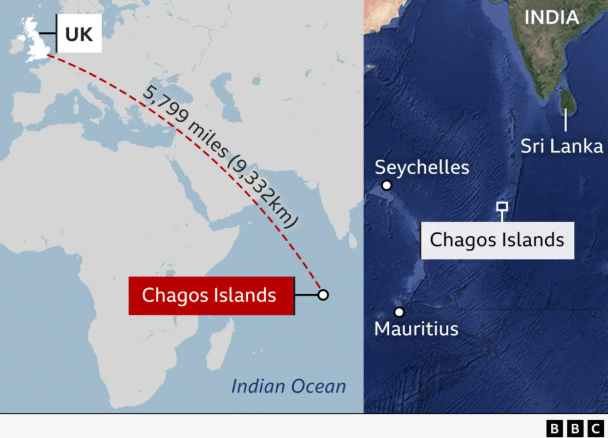
To the surprise of many, .io is not a generic top-level domain (such as .com or .net), but a country-code top-level domain (ccTLD). It was assigned in 1997 to the British Indian OceanTerritory(BIOT for short)—an archipelago that includes the strategically important Chagos Islands.
The historic turning point: After decades of colonial disputes and international pressure, the United Kingdom and Mauritius signed an official treaty on May 22, 2025. In it, the United Kingdom agreed to cede sovereignty over the entire Chagos Archipelago to Mauritius.
If this treaty is fully implemented, the following will occur under international law: The British Indian Ocean Territory (BIOT) will formally cease to exist—once the treaty has been fully implemented and the necessary laws have entered into force.
🛑 Update (mid-2026): The “Trump factor” puts the deal on hold
Implementation of the agreement stalled for a time because the U.S. government under Donald Trump raised security concerns regarding the Diego Garcia military base. Since the base can only be operated effectively with U.S. approval, Washington exerted considerable political influence on London. This delayed the parliamentary ratification of the treaty.
The implication for the domain industry: BIOT will continue to exist unchanged for the time being. For .io owners, this means an unexpected, immediate time savings—but it does not yet resolve the structural problem.
The ICANN Logic: Why a Disappearing Country Is Killing Domains
The real problem is not due to the map, but rather to the strict procedures of ICANN (Internet Corporation for Assigned Names and Numbers) and its subsidiary, IANA.
The set of rules works like a relentless chain reaction of dominoes:
[BIOT territory is dissolved] → [Removal of the “IO” code from the ISO 3166-1 standard] → [Triggering of the ICANN policy on the retirement of ccTLDs]
- The ISO Assignment: Every country-code top-level domain (ccTLD) is required to be based on the international standard ISO 3166-1 (an official list of two-letter country codes). If a region no longer exists politically, the ISO maintenance body deletes this code.
- The ICANN Retirement Policy: In September 2022, ICANN adopted a binding policy governing the orderly retirement of expiring ccTLDs (Policy for the Retirement of a ccTLD). If an ISO code is deleted, ICANN must take action.
Background Information for Professionals: The .su Precedent
The fact that Internet governing bodies take their own bureaucratic rules extremely seriously is evident in a very recent development: In early 2025, the IANA announced that it would initiate the retirement process for .su. Under current policy, the domain extension could expire by around 2030 within the designated transition periods, provided no changes are made. Although the country collapsed over 30 years ago and there are still over 100,000 active domains there, the unstoppable countdown to their final deletion from the root server is now underway, with the process set to be completed by 2030 at the latest. IANA does not deactivate domains overnight, but it does not forget about them either.
The Timeline: No Panic in the Digital World
If the Chagos Treaty were to be ratified in the future after all and the ISO code “IO” were to be removed, that would by no means mean that millions of websites would go offline tomorrow. The IANA guidelines provide for a strictly regulated, multi-year safety net in the event of such a scenario:
- The Notice of Removal: As soon as the ISO code is released, IANA sends an official notification to the registry operator (currently a subsidiary of Identity Digital).
- The 5-Year Transition Period: Starting on this date, a standard five-year transition period begins, during which the domains will remain fully functional to give website operators time to migrate.
- Renewal: For heavily used domain extensions such as .io (with an estimated 1.5 million or more registrations), this period may be extended for up to an additional five years.
The current policy generally provides for a transition period of up to ten years.
Three Scenarios: What’s Next for .io?
Since the domain extension is a massive economic factor (the registration fees alone bring in an estimated $40 million annually for the operator), three possible paths are being considered behind the scenes:
Scenario 1: Bureaucratic Downfall: The Hard ICANN Path
The agreements will be ratified, ISO will remove the code, and ICANN will stubbornly push through the retirement process. After a transition period of 5 to 10 years, .io will be completely shut down. Tech companies worldwide will have to migrate.
Scenario 2: The Takeover by Mauritius: The Commercial Path
ccTLDs can be extremely lucrative for small countries—just look at .ai (Anguilla), which is raking in hundreds of millions thanks to the AI boom. It is conceivable that a special political solution might be sought—for example, through special treatment of the ISO code or a redelegation of the registry. However, there is currently no official plan for this. In such a scenario, the code would not be deleted from the ISO registry but would be declared “reserved on an exceptional basis,” and administration of the domain would be officially transferred to Mauritius (redelegation).
Scenario 3: The “Grandfathering” Exception: The Political Path
Given the economic importance of .io, significant pressure from the tech industry is conceivable. Another theoretical possibility would therefore be a special political solution in which ICANN or Internet governance bodies establish new rules to preserve .io permanently. However, there is no precedent for such a move to date.
What does this mean in practice?
1. For Beginners & Founders: Should I Buy Another .io Domain?
- No immediate cause for concern: The issue has been postponed due to the current political veto by the U.S. And even in the worst-case scenario, the IANA deadlines guarantee a term extending well into the 2030s.
- Risk Assessment: For a short-term project or a quick MVP (Minimum Viable Product), .io remains fully usable. However, anyone looking to build a long-term, completely risk-free business might be better off choosing an alternative when starting a new company.
2. For Professionals, Tech Companies, and CTOs: What Should Be Done?
- Proactively Secure Secondary Domains: Anyone operating an established, valuable brand on .io should secure the corresponding equivalents under .com, .co, or modern technology domains now, while they’re still available.
- Infrastructure Check: Assess how deeply the .io domain is embedded in internal APIs, microservices, OAuth systems, and repositories. A sudden domain change in a few years must not paralyze the core technical infrastructure.
3. For Resellers & Agencies: Strategic Consulting
- Education, not scaremongering: Agencies can position themselves as competent, strategic partners by explaining the issue to clients in an objective manner. The news that the U.S. has blocked the deal for the time being takes the immediate pressure off client meetings.
- Leverage up-selling potential: Take advantage of the situation to offer customers defensive domain registrations (securing alternative extensions to protect their brand).
- Portfolio Valuation: Domain resellers who hold large portfolios of .io domains as investments need to keep an eye on volatility. The market value of .io keywords in the aftermarket could be sensitive to political news from Washington and London.
The bottom line: Keep an eye on the root server
The .io dilemma vividly illustrates just how closely digital identity and real-world geopolitics are intertwined. With the Chagos Treaty currently on hold, the .io domain extension is absolutely secure for the time being. However, its foundation has been permanently compromised.
For agencies and professionals, the rule is: observe rather than ignore. The coming years will show whether the rigid rules of Internet bureaucracy will be broken for the sake of the economic value of the .tech domain extension, or whether the Internet will have to say goodbye to its favorite “input/output” abbreviation in the long run.
Keep an eye on secure alternatives: If you want to remain completely untouchable geopolitically in the long term, stick to purely generic domain extensions:
- .app (Specifically for applications, operated and protected by Google)
- .dev (For developer platforms and web tools; also a Google registry)
- .tech (The universal, apolitical home for technology companies)







Leave a Reply