 Login
Login +49 5181 2869039
Choosing a domain name is one of the decisive steps when you start a new online project or want to make a brand digitally visible. A domain shapes the first impression, determines recognizability and helps to build trust. Finding domain names with AI is one of the most effective ways today to quickly and reliably develop creative ideas for your online project.
In this article, we provide you with a clear and reliable guide that shows you how to use AI specifically for naming, how to make good strategic decisions and what you should definitely pay attention to when choosing a domain extension.
1. AI-supported naming: quick ideas with high quality
Artificial intelligence can make the creative phase much easier for you. Instead of brainstorming for a long time, you can use AI-supported tools to generate numerous domain suggestions in seconds.
Did you know that in our dashboard you can use an AI-based domain search which generates creative and often immediately available suggestions based on your keywords, topics and target groups.

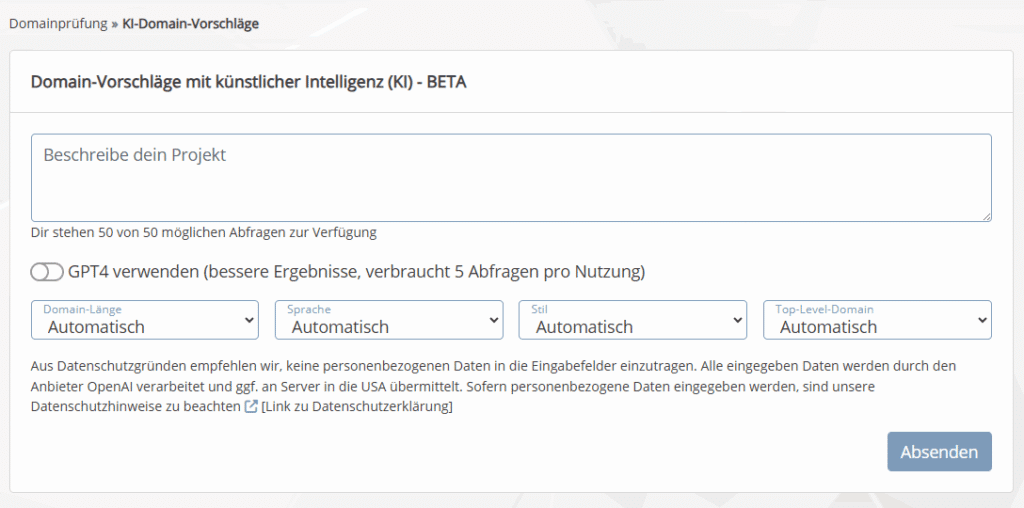
This is how the process works:
- You enter key terms, topics or brand ideas.
- The AI creates spontaneous variants: clear terms, abstract brand names, composites, fantasy names or word games.
- The suggestions become more and more suitable through targeted inquiries and fine-tuning.
The advantage: AI provides you with a wide range of suggestions, speeds up your decision-making process and opens up ideas that you might not have considered yourself.
2. strategic naming: how to make the right choice
Even if AI makes a lot easier, a systematic evaluation of the suggestions remains important. A good domain name should be short, unique, easy to pronounce and flexible to use. These categories will help you with your selection:
Fantasy names / artificial words
They open up a high degree of brand freedom and are very concise. Examples such as “Google” or “Kodak” show that artificial words can form strong brands in the long term. The advantage: they are usually easier to legally distinguish as a trademark.
Descriptive domains
Domains such as “handyreparatur-stadtname.de” show directly what is on offer. Clear terms can provide users with orientation and create thematic relevance. The disadvantage: Descriptive domains are often longer and less flexible if your offer expands later.
Composites and abbreviations
Examples such as “CyberTools24” combine brevity and clarity. They are particularly suitable for technical or service-oriented brands.
Linguistic aids
Dictionaries, synonym finders or auto-complete functions in search engines provide additional inspiration. What remains important, however, is that the domain should be easy to remember and pronounce.
Further evaluation criteria
- Domain length: Short domains are easier to remember and reduce typing errors.
- Readability: A clear structure facilitates recognition and word of mouth.
- Internationalization: If you work internationally, the spelling should be globally understandable. Umlauts and special characters can be impractical in some countries.
- Trademark law check: A quick search in the DPMA register, the EUIPO database or the WIPO Brand Database protects you from legal conflicts. Even if a domain is free, the term may be protected under trademark law.
Important: Keywords in the domain name are not a direct ranking factor, but can increase the click-through rate because users recognize more quickly what it is about. This can indirectly result in a positive SEO effect.
3. the right domain extension: Established TLDs create trust
The choice of top-level domain (TLD) influences how professional your domain looks. Established TLDs such as .de, .com or .net have enjoyed a high level of trust among users for many years.
Search engines treat all TLDs technically the same, but new or less well-known endings may be used more frequently for short-term projects depending on the context of use. This can affect how carefully search engines evaluate new domains before they are fully ranked.
This means that a widespread and reputable TLD can help to immediately convey a trustworthy impression.
When a hyphen is the better choice
If your desired name without a hyphen is only available under a TLD that is less established, while the same name with a hyphen is available under a more familiar extension, the hyphen is the more sensible choice.
Hyphens are completely unproblematic for search engines and often improve the readability of compound words. Hyphens have no negative technical effects on SEO or indexing.
Technical aspects that are often overlooked
- Make sure that your domain is delivered with HTTPS. Modern browsers mark HTTP pages as “Not secure”.
- Plan redirects if you have several variants or spellings.
- Use DNS settings properly to optimize loading times and avoid technical errors.
Register domains easily
With us, you can choose from over 700 domain extensions and manage your domains conveniently and clearly. The large number of TLDs offers you maximum flexibility – regardless of whether you want to have a global, regional or industry-specific presence.
Conclusion: AI and strategy in perfect harmony
The ideal domain name comes from a combination of creative AI suggestions, structured decision making and a trusted domain extension.
AI helps you develop ideas, but the final choice should always be made consciously and fit your brand.
If you are starting a digital project or want to optimize your online presence, now is the perfect time for your domain check in our ResellerInterface Dashboard.







Leave a Reply